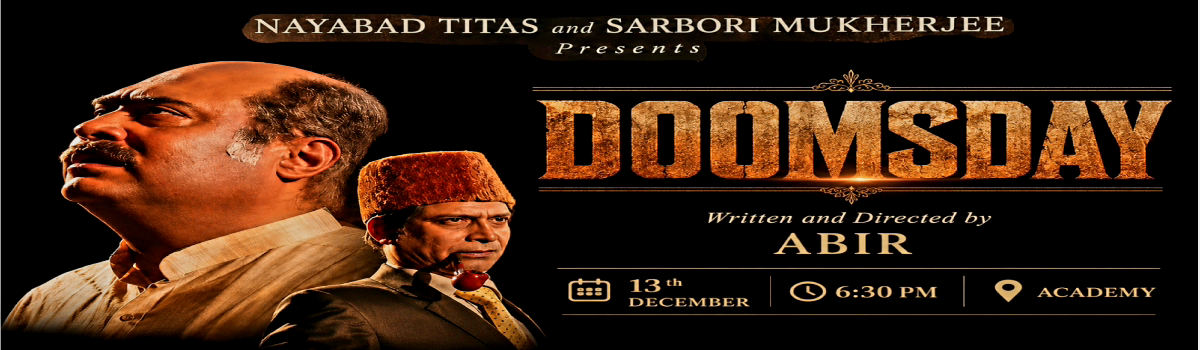
Doomsday
- 13 Dec, 26
- 06:30 PM - 08:00 PM
- Academy of Fine Arts: Kolkata
DOOMSDAY
A Historical Political Drama
- DOOMSDAY is a historical-political drama set against the turbulent final phase of British rule in India, culminating in the Great Calcutta Killings of 16 August 1946.
- The play examines the political decisions, ideological conflicts and competing visions of nationhood that brought India to one of the darkest moments of its pre-Independence history. At its centre is an imagined confrontation between Muhammad Ali Jinnah and Shyama Prasad Mukherjee—two political figures representing sharply different ideas about India’s future. The encounter is fictional; the historical circumstances surrounding it are real.
- The narrative unfolds against the backdrop of the Cabinet Mission Plan and the Wavell-era Grouping Scheme, through which an attempt was made to find a constitutional arrangement that could preserve India’s unity while accommodating the growing political demands of the Congress and the Muslim League. The divergent interpretations of the plan, particularly the question of provincial grouping, gradually deepen the political crisis.
- The play brings together the conflicting positions of the principal political forces of the period. Sardar Vallabhbhai Patel approaches political compromise as a possible means of securing independence while preserving the larger unity of India. Mahatma Gandhi remains deeply concerned with the moral consequences of political expediency. Jawaharlal Nehru resists any arrangement that, in his view, could compromise the secular and democratic character of an independent India.
- For Jinnah, however, the breakdown of political consensus becomes an opportunity to intensify the demand for Pakistan. Following the Muslim League’s withdrawal from constitutional cooperation and its call for Direct Action, the political crisis moves beyond negotiation and into the streets.
- On 16 August 1946, Calcutta witnesses an unprecedented eruption of communal violence. Death, fear and destruction engulf the city, exposing the devastating human consequences of political polarisation.
- It is in this historical moment that DOOMSDAY creates its central dramatic device: a fictional private confrontation between Jinnah and Shyama Prasad Mukherjee. Their debate moves beyond the immediate political crisis and confronts fundamental questions of nationhood, identity, communal politics, secularism, political strategy, responsibility and the human cost of power.
- The play does not seek to reduce history to a simple conflict between heroes and villains. Instead, it attempts to place competing political arguments within the moral and human realities of their time. Through the imagined encounter, the audience is invited to reconsider how political choices, ideological commitments and calculated strategies can shape the destiny of millions.
- The presence of Swami Pranabananda introduces another dimension to the narrative. His philosophical perspective, drawing upon the Bhagavad Gita, shifts the dramatic focus from political confrontation towards the deeper questions of duty, courage, restraint and responsibility. His presence serves as a counterpoint to a political world increasingly consumed by fear, anger and division.
- Ultimately, DOOMSDAY is not merely a reconstruction of the events of 16 August 1946. It is a theatrical inquiry into the political and human forces that preceded the catastrophe—and into the consequences when political objectives begin to overshadow the value of human life.
- The play asks:
- Could the tragedy of 1946 have been prevented?
- When does political strategy become an instrument of destruction?
- How far can political leadership be held responsible for the consequences of its decisions?
- And when a nation is divided, who bears the ultimate cost?
- The play concludes not with a simplistic political victory, but with the recognition of a profound responsibility: the responsibility to unite people, protect human life and preserve the idea of India.
- DOOMSDAY therefore looks at history not as a closed chapter, but as a continuing dialogue between the past and the present.
DIRECTOR’S NOTE
- DOOMSDAY is not a play about a day in history—it is a confrontation with the choices that created that day. I have approached the Great Calcutta Killings of 16 August 1946 not merely as a chapter of communal violence, but as the terrifying consequence of political calculation, ideological division and the failure of human responsibility. At the heart of the play is an imagined encounter between Muhammad Ali Jinnah and Shyama Prasad Mukherjee—a conversation that never took place in history, but one that allows the theatre to ask the questions history often leaves unanswered. Through their confrontation, I seek to examine the thin and dangerous line between political strategy and human catastrophe, between the pursuit of a nation and the destruction of its people. DOOMSDAY does not ask the audience to choose a hero or a villain; it asks them to confront the price that ordinary human beings are forced to pay when politics becomes more powerful than humanity. The presence of Swami Pranabananda and the invocation of the Bhagavad Gita introduce another dimension—the responsibility to act, to endure, and to protect what one believes is worth saving. My intention is not to recreate the past with nostalgia, nor to pass a convenient judgement upon it, but to hold a mirror to it—and, through it, to ourselves. Because the most frightening question history leaves behind is not “Who was responsible?” but “What will we do when we find ourselves standing at the same crossroads again?” DOOMSDAY is my attempt to make that question impossible to ignore.
- — Manoj Kumar Saha (Abir) – Writer & Director
Venue: Academy of Fine Arts
-
Premium @ ₹300
Stock:: 20 seats
-
Gold @ ₹200
Stock:: 20 seats
Premium₹300
Gold₹200